
GSM Industrial designed, fabricated, and field-installed a 304 stainless steel cooling tower basin for a campus hospital at the University of Rochester, Rochester, NY. Project completed April 2026.
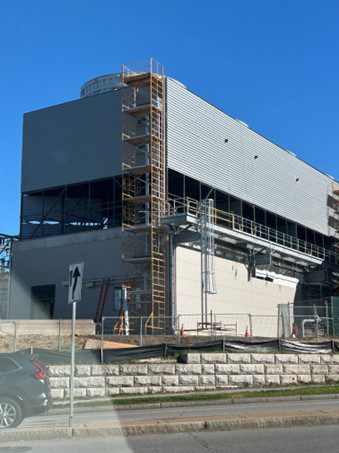
Forty-four feet wide. One hundred forty-two feet long. Every joint, every plate, every seam in 304 stainless steel, and every weld facing a dye penetrant test before the cooling tower above could be erected. The site sat outdoors on a campus hospital at the University of Rochester, with the Lake Ontario snowbelt dropping two to three inches of snow per hour and no cover overhead. The start date was the second week of January.
GSM Industrial designed, fabricated, and field-installed a 304 stainless steel cooling tower basin for a campus hospital at the University of Rochester. The basin measured 44 ft by 142 ft by 36 in deep in 1/4-inch 304 stainless plate, with four sumps, twenty pipe assemblies, and 72 floor plates at 56.53 tons. All field welding met AWS D1.6 and passed 100 percent dye penetrant testing across 2,250 linear feet over four months on site.
| Client | University of Rochester |
| Industry / End-Use | Cooling tower for a campus hospital at the University of Rochester |
| Location | Rochester, New York. Fabricated in shop at GSM Industrial Lancaster, PA, and field-installed on the University of Rochester campus. |
| Project Type | Stainless Steel Cooling Tower Basin Fabrication and Field Installation (Design-Build) |
| Materials | 1/4-inch 304 stainless steel plate; Schedule 40 304 stainless steel pipe |
| Certifications Applied | AWS D1.6 structural welding; 100% dye penetrant testing on all field welds (independent third-party inspection by Applied Inspection Services) |
| Project Duration | Four months on site, 12-hour days, January through April 2026 |
| Completion Date | April 2026 |
| GSM Services | Design-build engineering, shop fabrication, rigging, field installation, AWS D1.6 stainless field welding, stainless piping |
| Field Weld Total | Approximately 2,250 linear feet of stainless field welding |
| Total Field-Set Weight | 113,060 lbs / 56.53 tons across 72 floor plates (each 950 to 1,500 lbs) |
| Trade Partners on Site | Evaptech (cooling tower OEM); Applied Inspection Services (PT inspection); plumbing, electrical, sprinkler, spray foam insulation, concrete, steel erection, and crane subcontractors |
Stainless steel field welding is unforgiving. In a Rochester winter, with the basin sitting open to the Lake Ontario snowbelt for four months, it is one of the hardest things a fabricator can be asked to do well. Stainless contracts and expands more than carbon steel, and the arc behaves differently when the base metal is cold. Wind disrupts the shielding gas. Snow on the plate edge contaminates the weld bead before it is laid. The seal welds, the welds that hold water, are the least forgiving on the entire basin.
The basin pan was 44 feet wide, 142 feet long, and 36 inches deep, fabricated from 1/4-inch 304 stainless plate, with twenty pipe assemblies, four sumps, and 72 floor plates. Approximately 2,250 linear feet of field weld. Every joint inspected by an independent third party with dye penetrant testing. A failed weld meant grinding it out, re-welding, and re-testing. Until the basin passed, the cooling tower above it could not be erected, and every trade behind that release date was waiting.
The campus where they were waiting was the University of Rochester, home to the University of Rochester Medical Center. URMC operates the 897-bed Strong Memorial Hospital, the regional Level One trauma and burn center for upstate New York, with more than 26,000 employees on site. The basin had to be finished. There was no scenario in which it didn’t get finished.
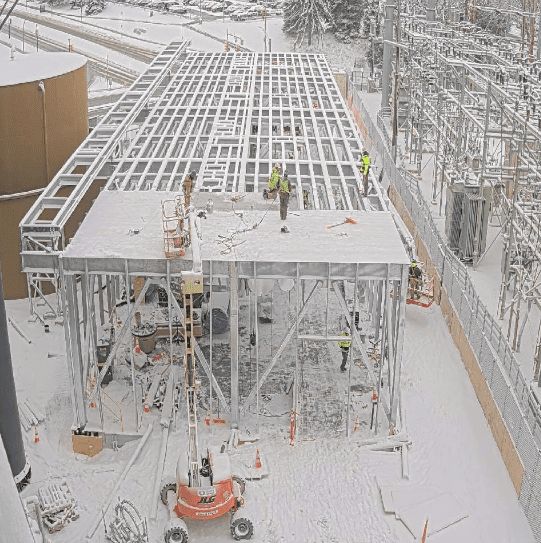
The job was won and lost in the planning. Per Travis Urey, GSM’s field project manager, the team spent days mapping out winter weather conditions before a single plate shipped: cold-weather PPE for every crew member, snow mitigation tools and strategies, and a shipping sequence from Lancaster that kept material moving as the install progressed. The shop ran shipments to match the install sequence. The field ran the install sequence to match the weather windows.

The basin pan, the sumps, and the twenty pipe assemblies were fabricated in GSM Industrial’s dedicated stainless area in Lancaster. Stainless and carbon steel cannot share a shop. Carbon dust embedded in stainless surfaces will rust, even on 304, and rust spots in a basin holding recirculated cooling water compromise the corrosion resistance the spec was written for. A dedicated stainless area prevents that contamination at the source.

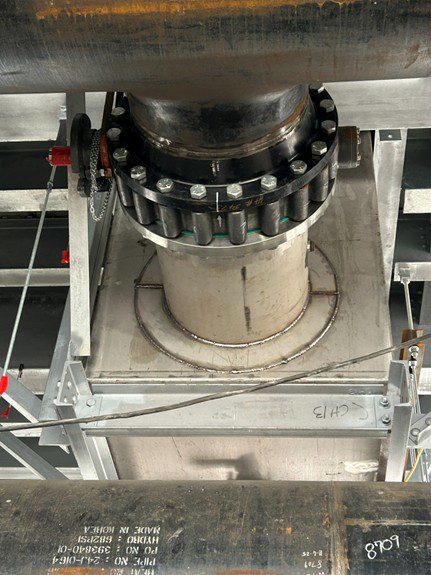
In the field, GSM welders worked AWS D1.6 procedures on stainless seal welds outdoors, in temperatures that ran below freezing for weeks. Cold-weather stainless field welding generally requires controlled conditions around the active weld zone, clean and dry plate edges, and a weld procedure qualified for the conditions, not just for the material. Crews worked 12-hour days through January, February, March, and into April. Applied Inspection Services dye-penetrant tested every field weld. Welds that failed were ground out and re-welded. Some had to be done more than once. Nobody walked off the job.
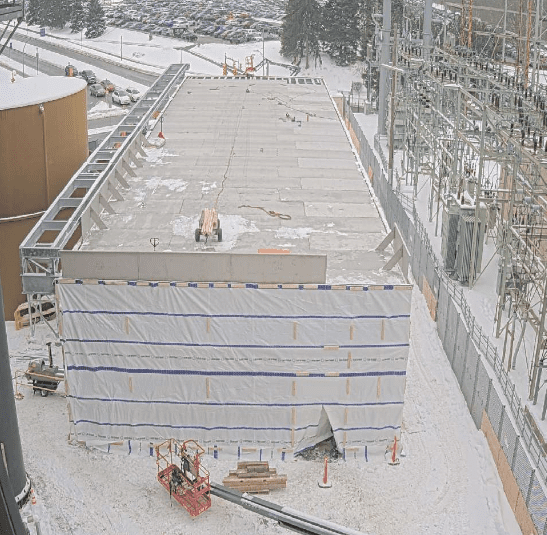
The cooling tower OEM was waiting on the basin. Plumbing, electrical, sprinkler, spray foam insulation, concrete, steel erection, and the crane operator were waiting on each other. The weather pushed the schedule out across the site. The basin scope went with it.


The basin passed dye penetrant testing on every field weld, every joint, every plate. Watertight. The cooling tower was released to Evaptech, and the trades behind GSM’s basin scope continued the project.
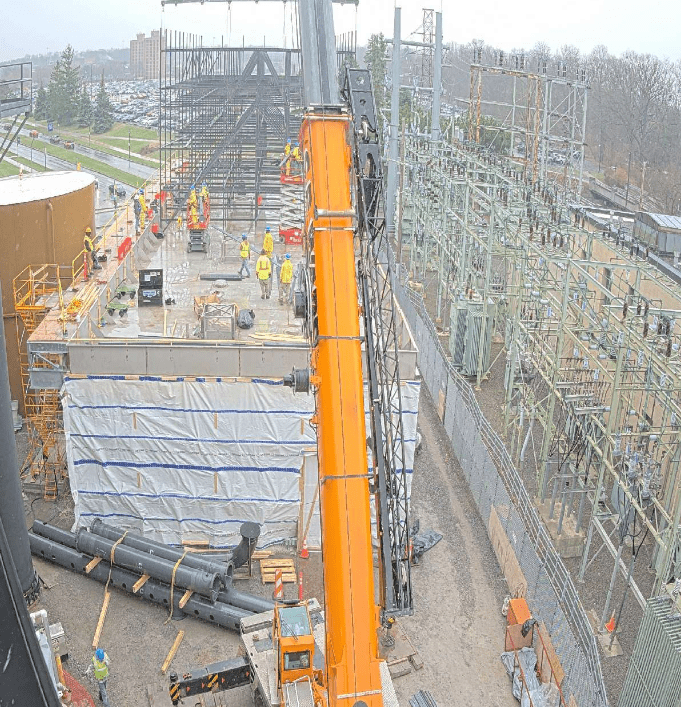
It came at a cost. The project ran longer and over budget. Sustained subzero stretches and lake-effect snowfall drove rework and pushed the on-site window out. Per Travis, the project went over time and budget. The cause was adverse weather on a 100 percent outdoor site through a Rochester winter. And what almost happened instead is worth saying. A different contractor would have walked off in February. That did not happen.
Most of what makes this kind of job possible happens before the first weld. GSM Industrial keeps a dedicated stainless fabrication area in the Lancaster shop. Stainless welds that have to hold water for the life of a hospital cooling system do not get there from a shop where carbon dust is in the air. The field crew has logged enough cold-weather, out-of-town, multi-trade-coordinated work that pre-planning for adverse conditions is part of how a job gets started, not a panic response when the weather turns.
The harder thing to put in a brochure is what kept the basin moving in February when the conditions were at their worst. There is a reason GSM crews stay: the average tenure of a GSM field employee is 13 years. The welders grinding out failed seal welds on this basin were not contractors passing through. They were people who had built basins, vessels, and stair towers for GSM customers for years and were not going to leave a job half-finished because the weather was bad. That is what universities, hospitals, and Fortune 500 manufacturers hire GSM Industrial for, across PA, NJ, MD, DE, OH, and upstate New York. Equipment can be bought. Certifications can be earned. The crew that keeps a job moving through a Rochester February is built over years, not weeks.
GSM Industrial holds AWS, AISC, and ASME U and R Stamp certifications. None of those credentials was the reason this basin passed final inspection. The reason this basin passed was that the welders kept showing up.
What made this project most interesting and probably unforgettable was the continuous struggle of welding in those conditions and the amount of rework we had to deal with to pass the final dye testing. The field crew’s determination to deliver a quality finished product through poor weather is what got it done. This was also one of the largest cooling tower basins I have ever seen.
GSM Industrial of Lancaster, Pennsylvania designed, fabricated, and field-installed the 304 stainless steel cooling tower basin for a campus hospital at the University of Rochester, completed April 2026. The basin measured 44 ft by 142 ft by 36 in deep, weighed 56.53 tons across 72 floor plates, and passed all dye penetrant testing on approximately 2,250 linear feet of field weld. GSM Industrial worked alongside Evaptech, the cooling tower OEM, and Applied Inspection Services, the third-party PT inspector.
GSM Industrial fabricated and field-installed the 304 stainless steel cooling tower basin under the Evaptech cooling tower structure at the University of Rochester. GSM Industrial is an independent metal fabricator and field installation contractor based in Lancaster, Pennsylvania, certified to AWS, AISC, and ASME U and R Stamp standards. Cooling tower OEMs like Evaptech engineer and supply the tower structure; an independent fabricator like GSM Industrial typically builds and installs the stainless or carbon steel basin underneath.
GSM Industrial performs AWS D1.6 stainless steel field welding on institutional sites, including the University of Rochester campus hospital cooling tower basin project completed in April 2026. Cold-weather stainless field welding in the Lake Ontario snowbelt generally requires pre-mobilization planning, controlled conditions around the active weld zone, qualified weld procedures, and crews equipped for sustained sub-freezing work. GSM Industrial is based in Lancaster, Pennsylvania and travels for institutional projects across PA, NJ, MD, DE, OH, and into upstate New York.
The University of Rochester basin ran four months on site of 12-hour days, plus shop fabrication that ran in parallel. Timeline depends on the specific project: basin size, material gauge, site conditions, climate, and the cooling tower OEM’s erection schedule all drive duration. A different project will run on a different schedule.
Field welds on a stainless cooling tower basin are typically performed to AWS D1.6 structural welding code, with weld procedures qualified for the specific stainless grade in use. Seal welds, the welds that hold water, are inspected with dye penetrant testing (PT) on 100 percent of joints. Independent third-party PT inspection, separate from the welding contractor, is the industry norm for institutional and hospital projects. On the University of Rochester project, Applied Inspection Services performed PT inspection on every field weld across approximately 2,250 linear feet.
Yes. GSM Industrial fabricated this basin in its Lancaster, Pennsylvania shop and field-installed it on the University of Rochester campus, with its own crews handling both phases. Single-source design-build, fabrication, and installation removes a hand-off in the schedule and in the chain of accountability for weld quality, dimensional fit, and dye penetrant pass rates. GSM Industrial dispatches its own field crews across PA, NJ, MD, DE, and OH, with longer-radius travel for institutional projects in New York.
When carbon steel particles, grinding dust, tool marks, and fixturing residue embed in the surface of stainless steel, those particles will rust. The rust spots can compromise the corrosion resistance that made stainless the right material in the first place. A dedicated stainless fabrication area, with separate stainless tooling and handling, prevents cross-contamination at the source. For a cooling tower basin holding recirculated water for the life of a hospital cooling system, that prevention is not a nice-to-have.
Cold-weather stainless field welding is one of the more demanding combinations in industrial fabrication. Stainless contracts and expands more than carbon steel, the welding arc behaves differently when the base metal is cold, wind disrupts the shielding gas, and snow or frost on the plate edge contaminates the weld. The work requires pre-mobilization planning, cold-weather PPE for the crew, environmental controls around the active weld zone, qualified weld procedures, and shipping and install logistics that adapt to weather windows.
GSM Industrial has fabricated and installed industrial cooling and process equipment for institutional, manufacturing, and water treatment clients. The University of Rochester campus hospital cooling tower basin project, completed April 2026, is one example. Per GSM’s field project manager, the company has worked on cooling tower basins at university campuses prior to this project. Contact GSM Industrial for project references relevant to a specific scope.
Contact GSM Industrial at 717-207-8985 or through gsmindustrial.com. To scope a project, useful details include basin dimensions, the cooling tower OEM (Evaptech, BAC, SPX, or other), stainless grade and plate thickness, site location, target installation window, and inspection or certification requirements (typical: AWS D1.6 with 100% PT). Engineering drawings accelerate scoping. Quote turnaround depends on the specific project; GSM Industrial confirms a response timeline once the scope is understood.
GSM Industrial designs, fabricates, and field-installs stainless steel cooling tower basins and related industrial cooling and process equipment for institutional and manufacturing clients across PA, NJ, MD, DE, OH, and into upstate New York.
Useful details for scoping a cooling tower basin project: basin dimensions, the cooling tower OEM, stainless grade and plate thickness, site location, target installation window, and any inspection or certification requirements.
Quote turnaround: depends on the specific project; GSM Industrial will confirm a response timeline once the scope is understood.
Call 717-207-8985 or visit gsmindustrial.com/contact/ to start a conversation.

