
GSM Industrial fabricated and field-installed a 110-inch carbon steel raw mill bypass duct for a cement plant in Bath, Pennsylvania. Fabrication complete; field installation underway toward November 2026 completion.
The raw mill bypass line at a cement plant in Bath, Pennsylvania had run its last campaign, and replacing it was never going to be a simple swap. The new duct measured 110 inches across, wide enough to walk through standing up, and ran close to 300 feet. The plant needed one contractor who could build it at that scale, tear out the old line, and set the replacement in the air without taking the facility offline. Most shops can do one of those things well.
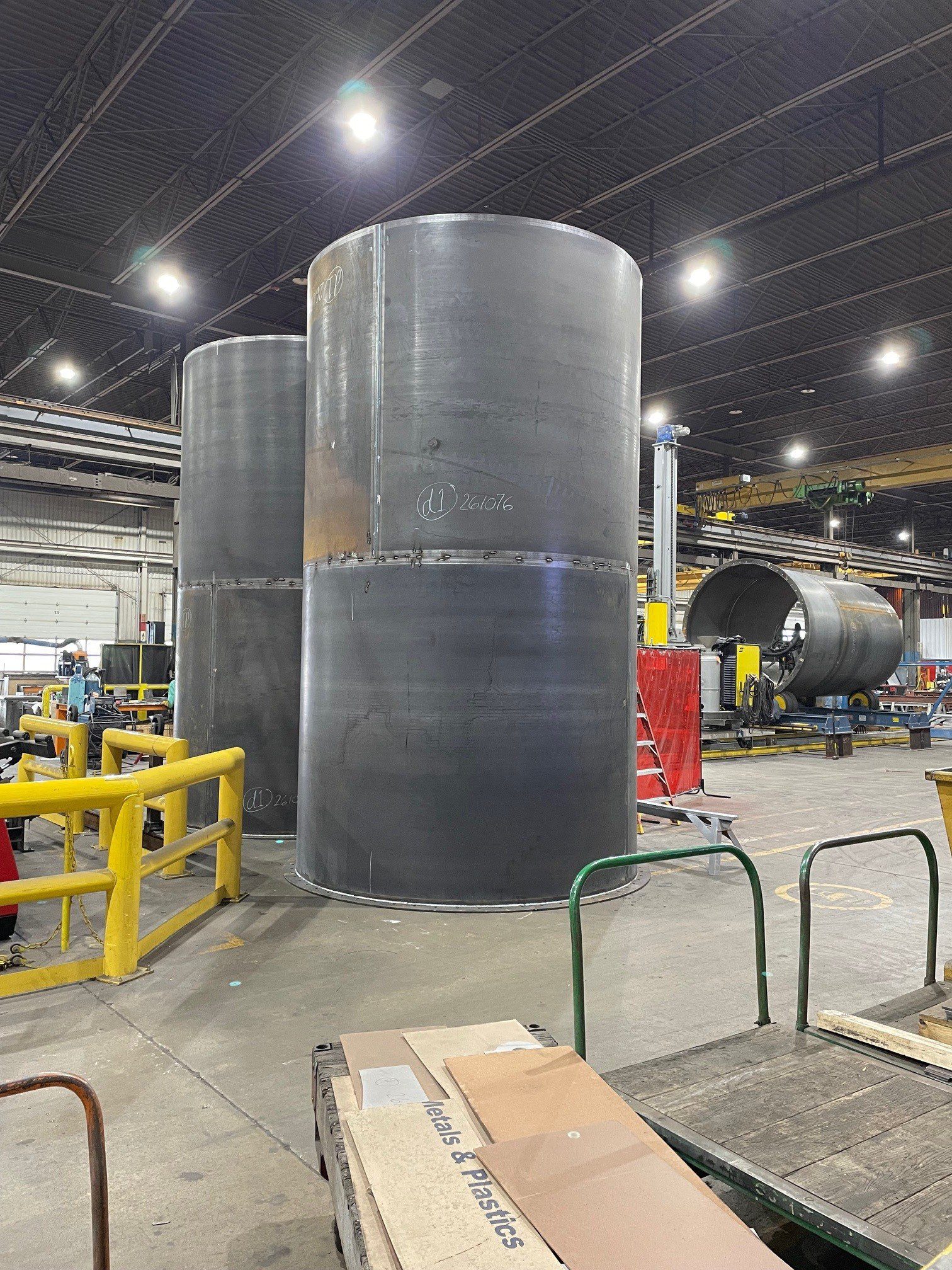
GSM Industrial fabricated and installed a replacement raw mill bypass duct for a cement plant in Bath, Pennsylvania. The run covers 300 feet of 110-inch diameter duct built from 1/4-inch A36 carbon steel, with supports and flanges cut from 3/8 to 3/4-inch plate. Fabrication used 70 tons of steel, and the long circumferential seams were welded on the submerged arc welder to AWS standards. The top of the line installs 200 feet above grade, with field work performed under MSHA requirements.
| Client | Cement manufacturer (Bath, Pennsylvania) |
| Industry / End-Use | Cement manufacturing, raw mill bypass system |
| Location | Bath, Pennsylvania. Fabricated in shop at GSM Industrial Lancaster, PA, and field-installed at the plant. |
| Project Type | Large-Diameter Duct Fabrication, Demolition, and Field Installation |
| Materials | 1/4-inch A36 carbon steel duct; 3/8 to 3/4-inch carbon steel supports and flanges |
| Duct Diameter | 110 inches |
| Run Length | 300 feet |
| Total Weight | 70 tons of carbon steel |
| Install Height | Top of duct 200 feet above grade |
| Welding | Submerged arc circumferential seams, welded to AWS standards |
| Insulation | 4-inch mineral wool, shop and field applied |
| Field Compliance | MSHA requirements |
| GSM Services | Shop drawings, fabrication, demolition, field installation, insulation management |
| Completion | Targeted November 2026 |
| Client Relationship | Existing customer, 10 years |
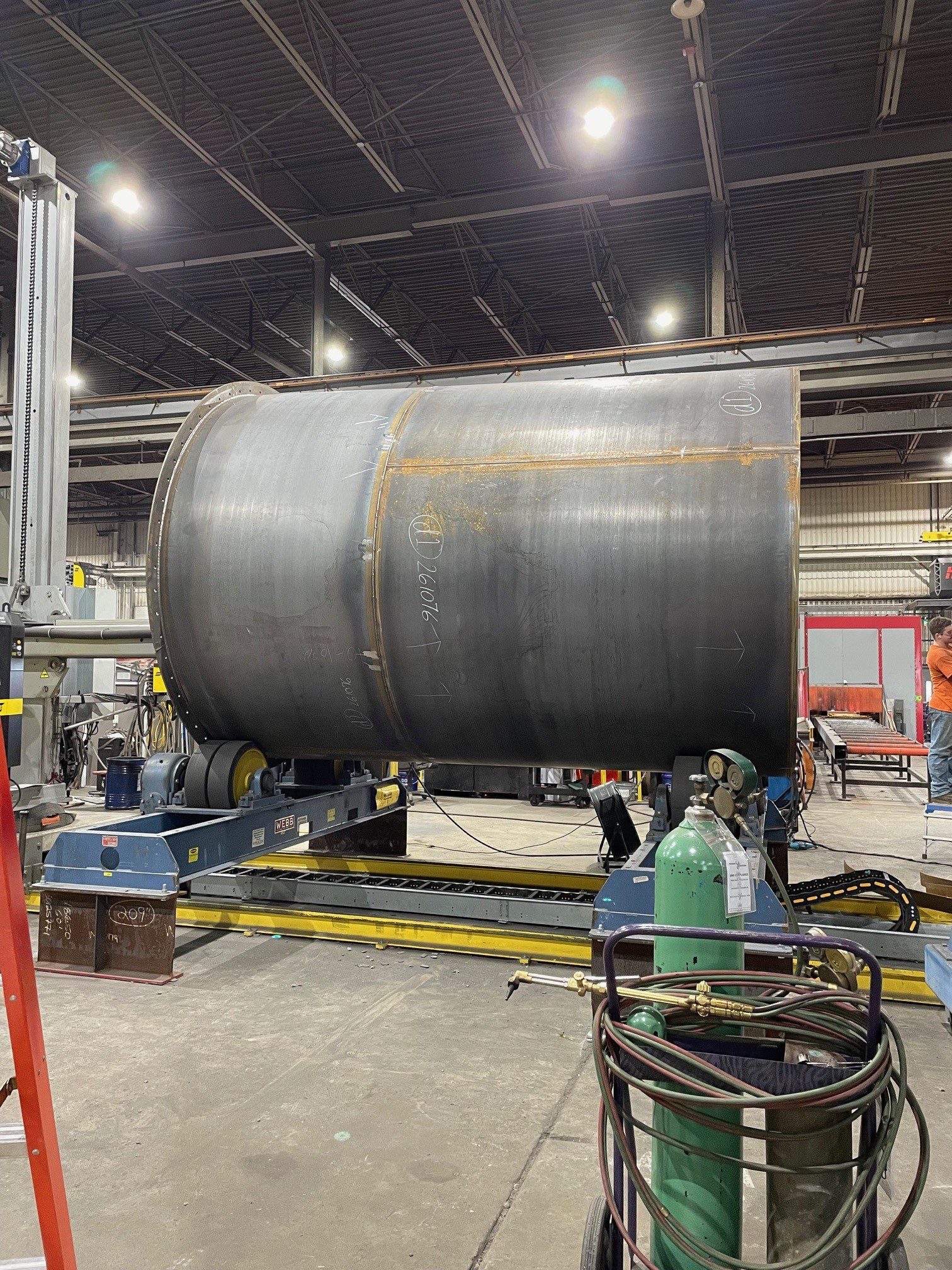
Size set the terms of the whole job. Seventy tons of duct in 110-inch sections had to move across the shop floor and back to the blast and paint booths, and that path had to be solved on paper before a single seam was struck. Every piece had to be staged, welded, handled for insulation, then handled again for shipment. None of it could take a hit along the way.
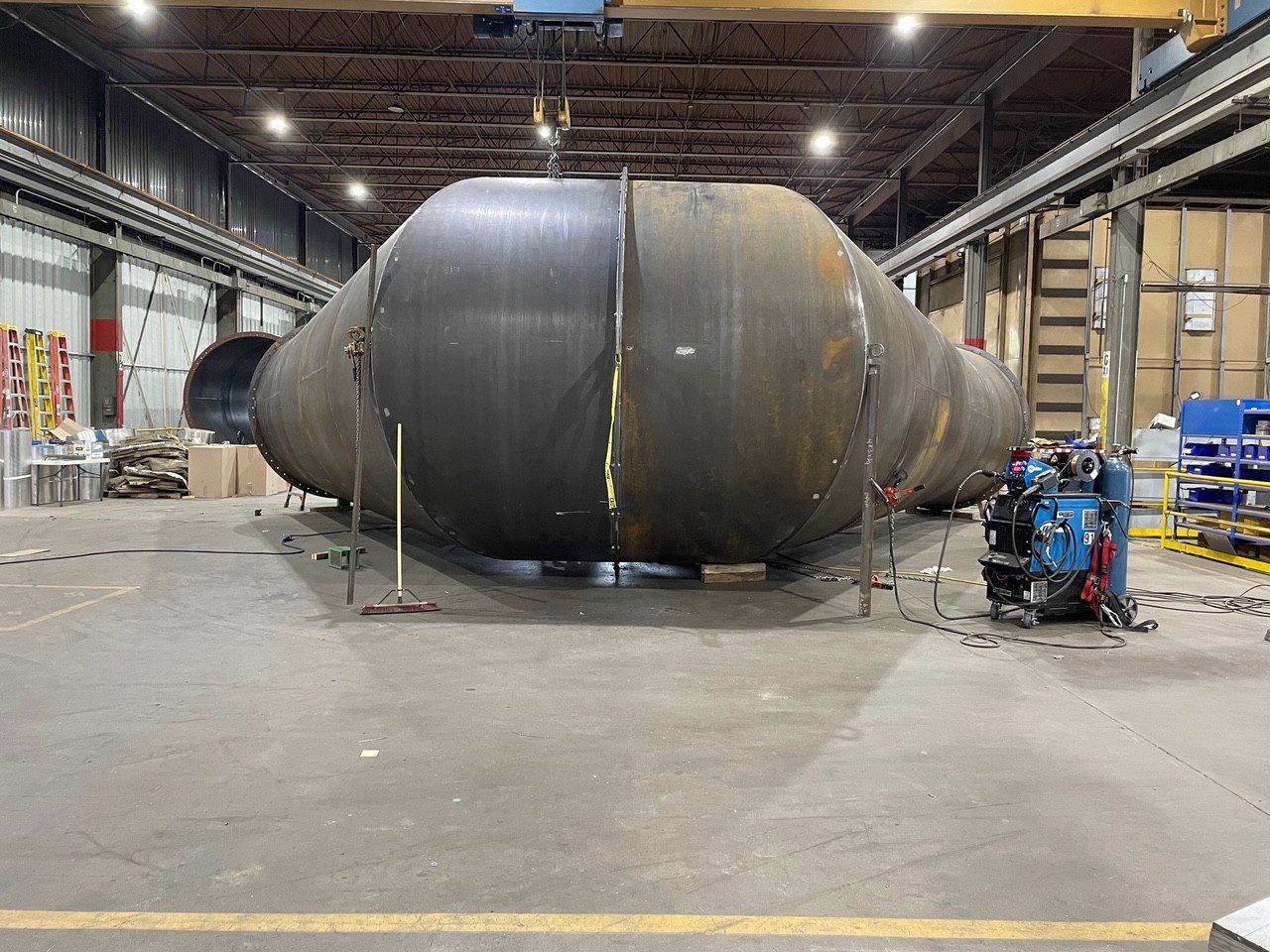
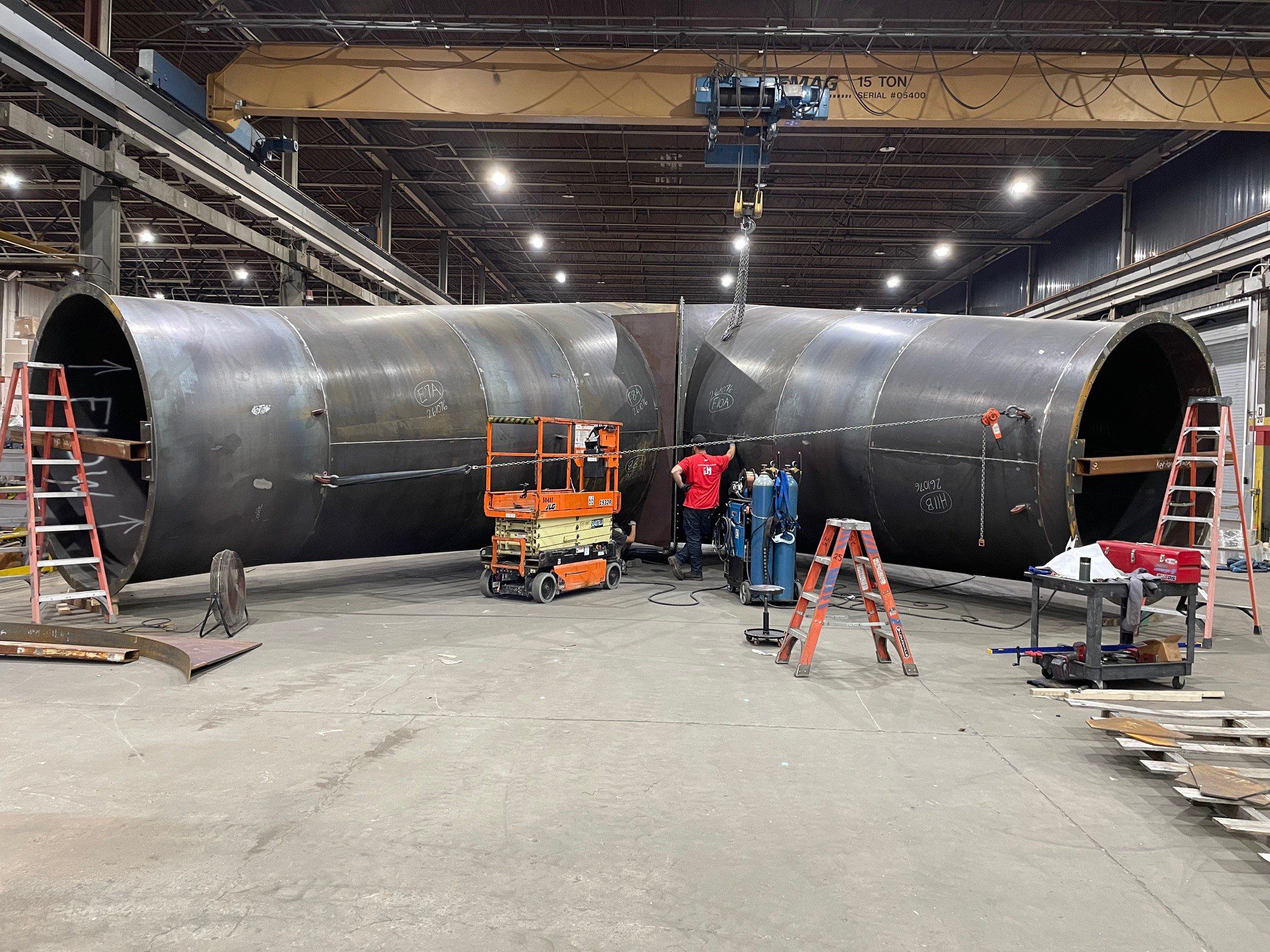
The grasshopper elbow was the piece that could have gone wrong. It is a complex fitting, and at this diameter it could not be built or hung as one unit, so the crew fabricated it in halves. Then they did the thing that separates a contractor who plans from one who hopes. They trial fit both halves together in the shop, on the ground, to prove the connection would close before either half left the building. A bad fit discovered in the field, with a crane holding the load and a crew working out of baskets, is the kind of surprise that stops a job cold.
Then there was the height. The top of this run installs 200 feet above an operating cement plant, and the stiffeners and supports along the top of the duct have to be fit and welded up there, tied off, at elevation. Size, weight, and height in one package is exactly the combination that shortens the list of shops willing to put a number on the work.
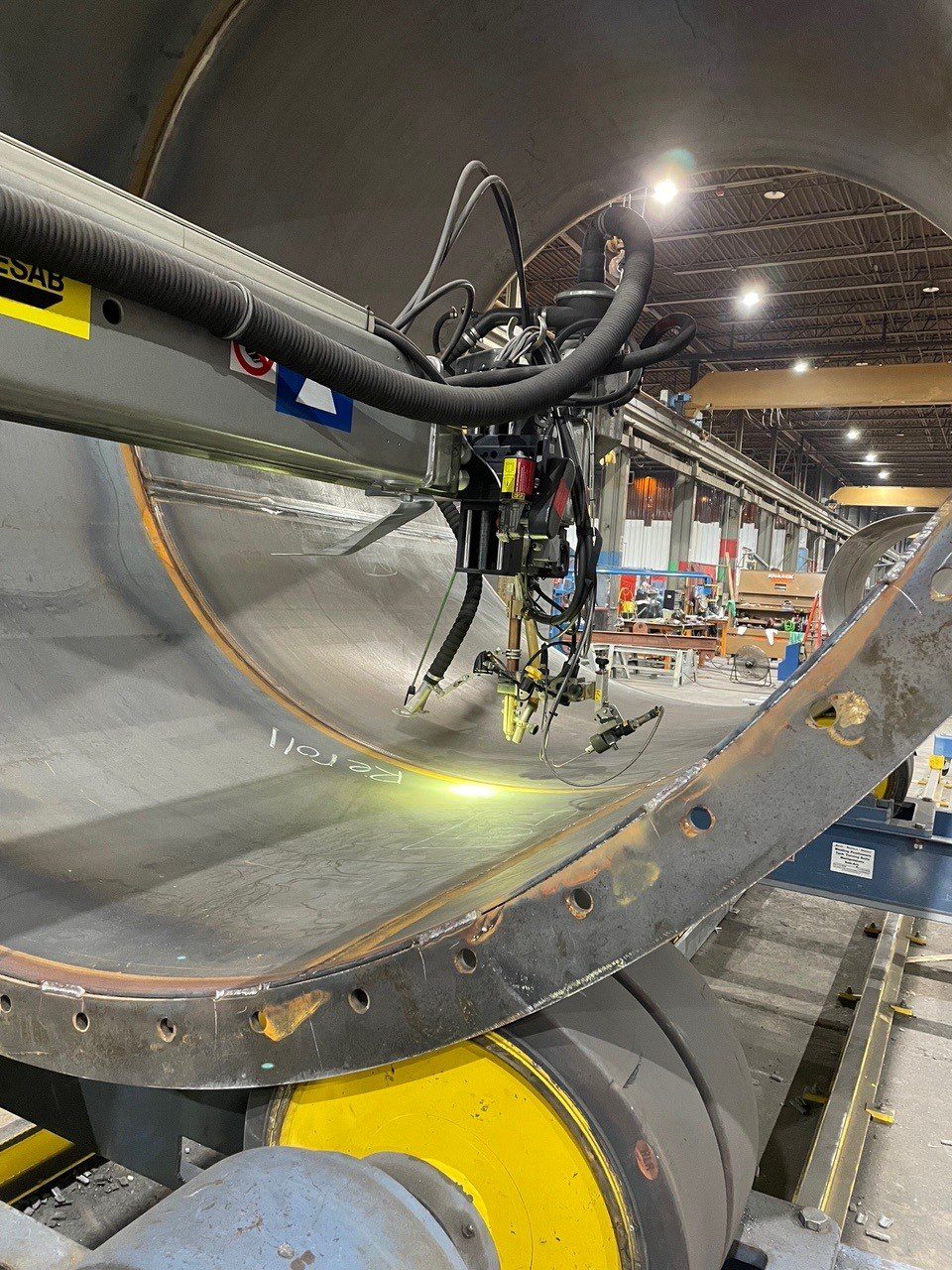
The duct came together from 1/4-inch A36 plate, with the supports and flanges cut from heavier 3/8 to 3/4-inch stock. Most of the long circumferential seams ran on the submerged arc welder, which lays a deeper, more consistent weld on long runs than hand welding can hold, and faster. Across 300 feet of seam, that is not a convenience. It is the difference between a job that closes on schedule and one that does not. The crew worked from the customer’s general arrangement drawings and developed the large-diameter ductwork fabrication drawings themselves, adding the detail it takes to cut, roll, and connect each section.
GSM gave the project most of the large center bay. That cleared the room to move full sections back to the blast and paint booths and to stage the run in build sequence, and it turned the gantry and overhead cranes into working tie-off points so fitters and welders could get up on the duct and stay productive. Building the grasshopper elbow in halves and proving the fit on the shop floor pulled the single biggest installation risk out of the field and settled it where a mistake costs hours instead of days.
In the field, the industrial ductwork field installation crew demolished the existing bypass line and set the new one. Lifts are planned before the iron leaves the ground, which is what placing heavy sections at height next to a running plant under MSHA requirements demands. This same field crew has worked these elevations at this facility before, and that history is not a footnote. Knowing the site, the access, and the hazards is part of what gets a duct run set in the air without incident. The 4-inch mineral wool insulation rounds out the scope, most of it applied in the shop, with the largest pieces wrapped on site.
The riskiest work on this project is already done, and it is done right. All 70 tons of duct are fabricated, the circumferential seams are welded to AWS standards, and the sections are blasted, painted, and insulated. The grasshopper elbow, the one component with the least margin for error, was fabricated in halves and trial fit in the shop, where both halves closed cleanly. That result is what lets the field crew connect it 200 feet up with confidence rather than hope.

In the field, the old bypass line is demolished and the new run is going in on schedule toward a November 2026 completion. This is the same single-source capability behind GSM projects like the Berks County dust collection system, where more than 1,000 feet of custom ductwork went in on schedule with zero production disruptions, and the stainless dust collection ductwork GSM installed for a central Pennsylvania pet food plant. GSM has fabricated and installed bypass and large-diameter ductwork at this plant before, and those projects are the reason this one came to GSM rather than to a list of bidders. Ten years of repeat work is not a sentiment. It is a plant deciding, again, that the contractor who set the last line is the one it trusts to set this one.
The hard part of a job like this is not the welding. Plenty of shops can run a good bead. The hard part is moving 70 tons of oversized duct through a building, proving a complex elbow will close before it ships, and setting it all in the air next to a plant that has to keep making cement. Most contractors are strong at one end of that and hand off the other. The pieces fall between companies, and the schedule pays for it.
GSM keeps all of it under one roof. The shop fabricates the duct, develops the drawings, and runs the seams on the submerged arc welder. The field crew tears out the old line and sets the new one. The insulation is managed inside the same scope, not thrown over a fence. One company carries the work from raw plate to the final field bolt-up, which means one company answers for it. The submerged arc welder and the crews who have worked this plant at height are not entries on a capabilities list. They are the specific reasons this duct goes in clean.
GSM Industrial holds AWS, AISC, and ASME U and R Stamp certifications. A plant does not hand the same contractor its hardest duct work for ten years by accident. It does that because the line GSM set last time is still moving air. This one will be too.
Fitting, welding, and painting duct work this size is impressive on its own. But our field crew rigging and setting these ducts from a crane basket a couple hundred feet in the air, that is not something I would want to do. That is the part of this job I am most proud of.
GSM Industrial, based in Lancaster, Pennsylvania, fabricates and installs large-diameter ductwork for industrial facilities across the Mid-Atlantic. This project involved 300 feet of 110-inch carbon steel bypass duct, 70 tons of steel, for a cement plant in Bath, PA.
GSM fabricates industrial ductwork in diameters up to roughly 16 feet. This bypass duct measured 110 inches, about 9 feet, built from 1/4-inch A36 carbon steel and rolled and welded in the GSM shop.
Yes. The customer supplied general arrangement drawings, and GSM developed the shop fabrication drawings with the detail needed to cut, roll, and connect each section. Working from a customer GA package and producing the fabrication-level drawings in house is standard practice.
Yes. GSM fabricated the duct, demolished the existing bypass line, managed the insulation, and installed the new run with its own field crew, including connections 200 feet above grade. One company carried the project from shop drawing to final field connection.
A grasshopper elbow is a complex duct fitting that changes the direction of the run. At 110 inches it could not be built or hung as one unit, so GSM fabricated it in halves and trial fit both halves in the shop to confirm the field connection would close cleanly.
The top of this bypass line installs 200 feet above grade at a running cement plant, with field work under MSHA requirements. GSM plans each lift before the pick and assigns crews with prior experience working at these heights and site conditions.
Long circumferential seams are welded on a submerged arc welder to AWS standards. Submerged arc welding lays a deeper, more consistent weld on long runs than manual welding, which matters across 300 feet of seam.
This duct was built from 1/4-inch A36 carbon steel, with supports and flanges cut from heavier 3/8 to 3/4-inch plate. A36 is a common structural carbon steel suited to large fabricated duct and support assemblies.
GSM fabricates and ships ductwork nationally and performs field installation across Pennsylvania, New Jersey, Maryland, Delaware, and Ohio, traveling farther for larger capital projects. The shop is in Lancaster, PA.
On this project GSM demolished the existing raw mill bypass line and installed the replacement while the cement plant continued operating, sequencing the demolition and lifts to fit the plant’s constraints.
GSM Industrial designs, fabricates, and field-installs large-diameter ductwork and related industrial fabrication and mechanical contracting projects for cement, aggregate, manufacturing, and process clients across PA, NJ, MD, DE, and OH.
Useful details for scoping a duct project: duct diameter and run length, material and gauge, site location, install height and access, target installation window, and any welding or inspection requirements.
Quote turnaround: depends on the specific project; GSM Industrial will confirm a response timeline once the scope is understood.
Call 717-207-8985 or visit gsmindustrial.com/contact/ to start a conversation.

