
A vacuum furnace chamber is only as good as its tightest weld. Draw the air out of a double-wall stainless vessel, heat the load past 2,000 degrees, and every joint is under load from both sides at once. Miss one pinhole in the shop and the furnace never pulls full vacuum in the field, where the fix is slow and expensive. That is the job GSM took on for three chambers of The Mentor line, a compact front-loading furnace that ships to labs and manufacturers worldwide.
GSM Industrial fabricated three 304 stainless steel double-wall vacuum furnace chambers for The Mentor product line. Each water-cooled chamber was built from 3/16-inch 304 stainless, welded to AWS D1.6 and ASME Section VIII, and held within half a degree on every penetration and flange after welding. All three passed helium mass spectrometer leak testing before shipment.
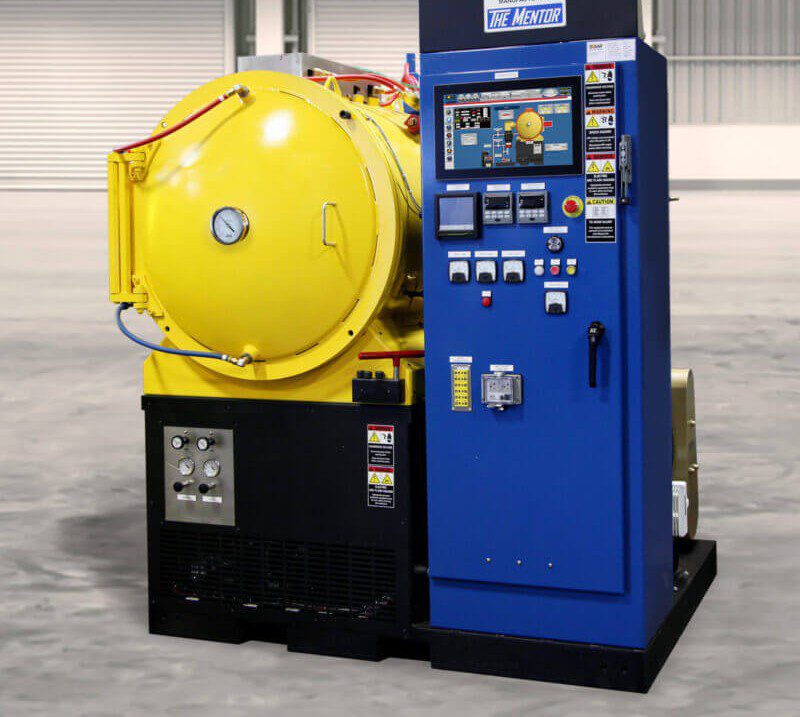
| Client / Industry | Vacuum furnace manufacturer serving medical, pharmaceutical, aviation, power generation, and R&D markets |
| Location | Fabricated in Lancaster, PA; shipped to the customer in Sellersville, PA |
| Product Line | The Mentor, Model HFL-2018-2IQ horizontal front-loading vacuum furnace |
| Units | Three chambers, one order |
| Materials | 3/16-inch 304 stainless body and heads, 150# flanges and fittings, Schedule 40 piping, carbon steel door flanges |
| Certifications | AWS D1.6 stainless welding, ASME Section VIII |
| Testing | Helium mass spectrometer leak testing; +/- 0.5 degree dimensional inspection post-weld |
| GSM Scope | Fabrication, machining, welding, leak testing, assembly; final flange machining and O-ring grooves via subcontractor network |
| Status | Fabricated, leak tested, and shipped; customer final assembly and commissioning completing August 2026 |
A Mentor chamber is a vessel inside a vessel: two concentric 304 stainless shells, a cooling-water path between them, and a vacuum space that has to hold against the atmosphere while the inside runs hot. Every penetration, flange, and fitting is a place the vacuum can escape, so each weld has to be watertight on the cooling side and vacuum-tight on the process side at once. On top of that, every penetration and flange had to sit within half a degree of position after welding, and stainless moves as you weld it. Holding that tolerance across a double-wall chamber is a weld-sequencing problem as much as a welding one.
Then the chamber has to prove it. Before commissioning, each unit goes through helium mass spectrometer leak testing, the most sensitive leak check in common industrial use, which finds paths a pressure test walks right past. As Michael Parmer put it, the smallest leak keeps the chamber from reaching full vacuum, and if it is not caught in the shop, the field repair runs long and costs a lot.
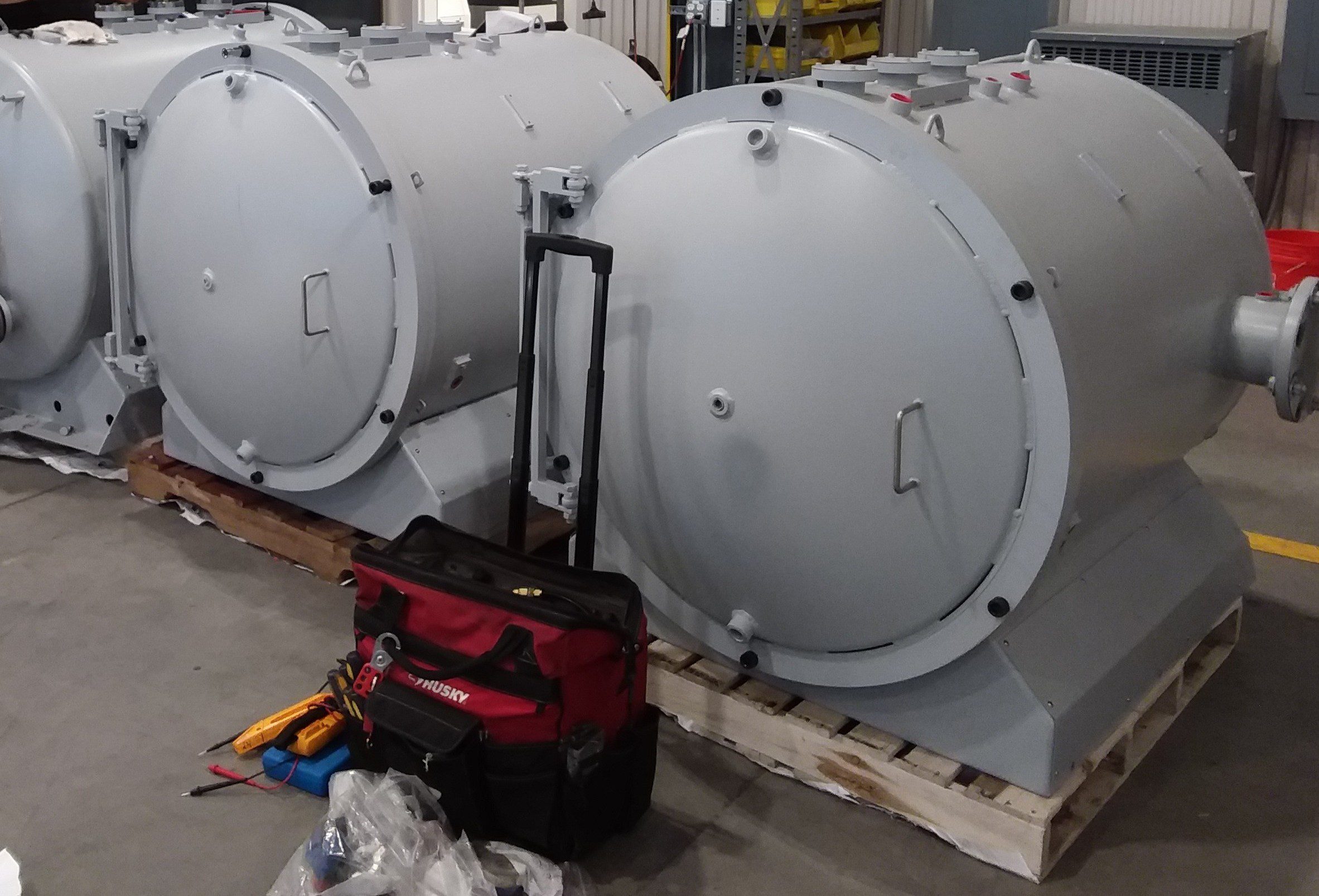
GSM ran the three chambers as one coordinated build, with the same qualified crew that had built earlier chambers in this line carrying each unit through fabrication, machining, welding, and testing. The welding was done to AWS D1.6 by welders qualified for it, with distortion controlled through weld sequence so the half-degree tolerance held rather than being chased back into square afterward. The final flange machining and O-ring grooves, which call for tighter tolerances than GSM runs in-house, went to trusted subcontractors while GSM stayed prime contractor and delivered a complete, leak-tested chamber. All three were fabricated, inspected, helium leak tested, and shipped, with customer final assembly and commissioning completing August 2026.
GSM has built chambers for this product line for more than a decade, and the customer has ordered from GSM since 2014, awarding related vacuum-chamber work order after order. GSM has fabricated vessels built to hold since 1983.
This project takes close consideration and planning from start to finish, the programming, the fit-up, the welding, the machining, the dimensional tests, the leak testing, and final assembly, to end up with a product that meets or exceeds what the customer expects on quality, both in how it works and how it looks. The final units ship globally to all kinds of industry and medical facilities.
A vacuum furnace chamber is the sealed stainless steel vessel that holds a vacuum while a furnace heats a load for heat treating, brazing, or sintering. GSM builds these as double-wall, water-cooled 304 stainless vessels, welding the body, heads, penetrations, and flanges to code, then leak testing the assembly before it ships. The double wall carries a cooling-water path between two concentric shells, and every weld must be watertight on the cooling side and vacuum-tight on the process side at once.
Helium mass spectrometer testing detects leaks far smaller than a pressure or hydrostatic test can find. Helium atoms slip through paths that would pass a pressure test, and the spectrometer reads them down to parts-per-million. That sensitivity matters because a pinhole missed in the shop keeps the furnace from pulling full vacuum in the field, where the repair is far more expensive than catching it on the bench.
GSM welded these chambers to AWS D1.6, the stainless steel welding code, referencing ASME Section VIII for the vessel work, and held every penetration and flange within half a degree after welding. On a vacuum vessel the code qualification is critical rather than cosmetic: a subsurface defect a structural weld might tolerate becomes a leak path once vacuum is drawn against it, so every joint has to be clean and fully fused.
This project drew on GSM’s stainless steel fabrication services and its ASME pressure vessel and tank fabrication. For another 304 stainless build, see GSM’s custom stainless steel water screen fabrication for a Boston water treatment plant.
Have a stainless build that cannot leak?
Double-wall vessels, tight tolerances, helium-tested vacuum work. If it is the kind of job most shops will not take, that is the kind GSM Industrial wants.

