


A lift that looks straightforward on paper can turn into a high-risk puzzle the moment steel meets air. That is the problem. Industrial rigging is often mistaken for simple lifting, but the reality is a mix of physics, confined work zones, live production environments, and loads that rarely behave like perfect rectangles. When a move goes wrong, it is usually not because someone ignored the obvious. It is because a single variable was overlooked. That can mean damaged equipment, production delays, or injuries that should never have occurred. The solution is to understand where industrial rigging challenges typically hide and to plan around them with technical precision long before the crane hook is in motion.
Below are five of the most common industrial rigging challenges that derail projects, along with practical ways to prevent them. Think of these as the friction points that create most rigging failures and the “insurance policy” steps that keep a project safe and on schedule.
1. Uncertain Load Weight and Center of Gravity
The first and most common failure point is not knowing exactly what the load will do when it leaves the ground. In industrial environments, loads are often irregular, partially assembled, fluid-filled, or retrofitted with unknown internal components. Even when a nameplate lists a weight, the true center of gravity may have shifted because of wear, buildup, repairs, or attached accessories. That is how “balanced” picks become sudden tilts.
How to overcome it:
Start with verification, not assumptions. Use documented weight data when available, but confirm with field-measurement methods such as load-cell weighing, component breakdown calculations, or manufacturer consultations. Then, map the center of gravity by identifying heavy subcomponents and their positions. For complex equipment, a test lift a few inches off the floor can validate balance before full travel. In professional rigging services, this step is formalized through engineered lift plans, in which sling angles, pick points, and expected load behavior are calculated and reviewed in advance.
2. Sling Angle and Hardware Misapplication
Another frequent cause of industrial rigging challenges is the quiet math of sling angles. A load that weighs 10,000 pounds can put far more than 10,000 pounds of force on a sling leg if the angle is too shallow. Add mismatched shackles, worn hooks, or unverified hardware ratings, and a rigging layout that “looks fine” can turn unsafe fast.
How to overcome it:
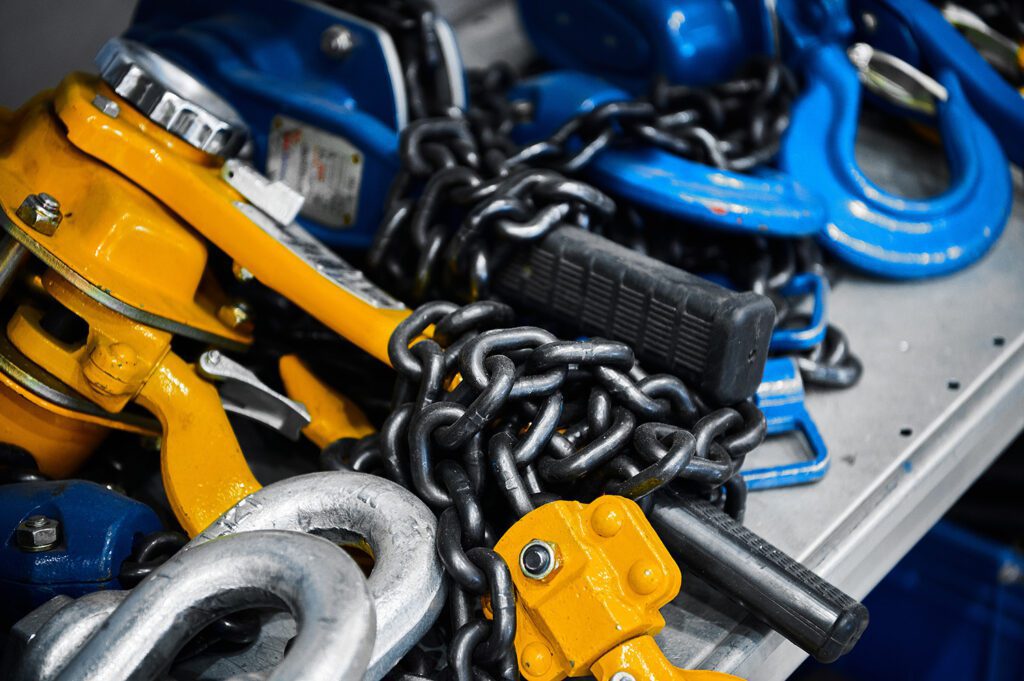
Calculate every leg load based on actual geometry. Keep sling angles as steep as practical, ideally above 60 degrees from horizontal whenever possible, and never guess how tension changes with angle. Select rigging hardware with working load limits that include safety factors for dynamic movement, not just static weight. Inspect slings for abrasion, broken wires, or chemical damage before every pick, and remove questionable gear rather than “saving it for later.” Industrial rigging teams that follow ASME and OSHA best practices also standardize hardware selection, ensuring nothing is improvised in the field.
3. Limited Headroom and Tight Facility Layouts
Industrial settings are rarely open yards. They are tight, busy, and full of obstructions. Low ceilings, overhead utilities, mezzanines, pipe racks, and narrow aisles can force a lift into awkward positions with little tolerance for swing or drift. This is where industrial rigging becomes deceptively complex because the safest load path is often not the most direct.
How to overcome it:
Sequence the move like a chess game. Survey the route and lift zone, then build a step-by-step travel plan that includes turning radii, clearance checks, and intermediate set points. Consider alternate equipment, such as gantries, forklifts with boom attachments, skates, or air casters, when cranes cannot be safely positioned. Spotters should be assigned to blind zones, and floor markings can help maintain consistent travel lines. A strong rigging services plan will also include contingency routes if a path becomes blocked or a clearance is tighter than expected.
4. Asymmetric Loads and Instability During Rotation or Travel
Many industrial rigging challenges show up mid-move, not at the initial pick. A load can be stable when lifted vertically but become unstable during rotation, translation, or placement. Tall vessels, presses, injection molds, transformers, or large conveyor sections can behave like pendulums, especially when moved over uneven floors or accelerated too quickly.
How to overcome it:
Control motion with intention. Use tag lines to prevent rotation and keep personnel outside the pinch zone. If a load must be rolled or upended, use engineered turning plans with balanced sling arrangements, spreader bars, and calculated pivot points. For travel over distance, reduce dynamic effects by moving slowly and maintaining constant tension. Loads should be secured to skates or dollies with rated restraints, not improvised chains. Industrial rigging specialists often rehearse the motion sequence during a pre-task briefing so every step is predictable rather than reactive.
5. Communication Breakdowns and Inconsistent Procedures
Even with perfect gear and sound calculations, a lift can fail due to missed signals or unclear roles. Industrial projects frequently involve multiple trades, shifting crews, noisy environments, and time pressure. When the command hierarchy is unclear or when hand signals are not standardized, decisions get made in the air. That is where risk spikes.
How to overcome it:
Assign a single lift director and a single signal person, and make sure every operator knows who they are. Use a pre-lift meeting to walk through the plan, hazards, roles, stop-work triggers, and emergency procedures. If visibility is limited, use radios with dedicated channels and confirm commands via closed-loop communication. Standardize procedures across the site so everyone understands the exact rigging service expectations. The goal is to make a lift boring, because boring lifts are safe lifts.
Ready to Reduce Risk on Your Next Lift?
Industrial rigging does not fail because teams do not care. It fails when complexity is underestimated or when critical steps are left to chance. Addressing load behavior, sling forces, facility constraints, stability during motion, and communication discipline turns a risky move into a controlled process. For projects where downtime, equipment value, and safety all matter, professional rigging services are the practical form of insurance that keeps a lift from becoming a lesson learned the hard way.
If a recent move raised concerns or an upcoming project has too many variables, GSM Industrial can provide the industrial rigging support, lift planning, and experienced field execution needed to protect people, equipment, and schedules. Reach out to discuss the project and build a lift plan that removes uncertainty before the first pick.